A while back I went to visit a friend who owns a shop. Between one coffee and the next, the conversation drifted to where it always goes when two business owners get together: the usual customer complaints, the margins squeezed by the marketplaces, and the tight response deadlines those portals demand from the seller.
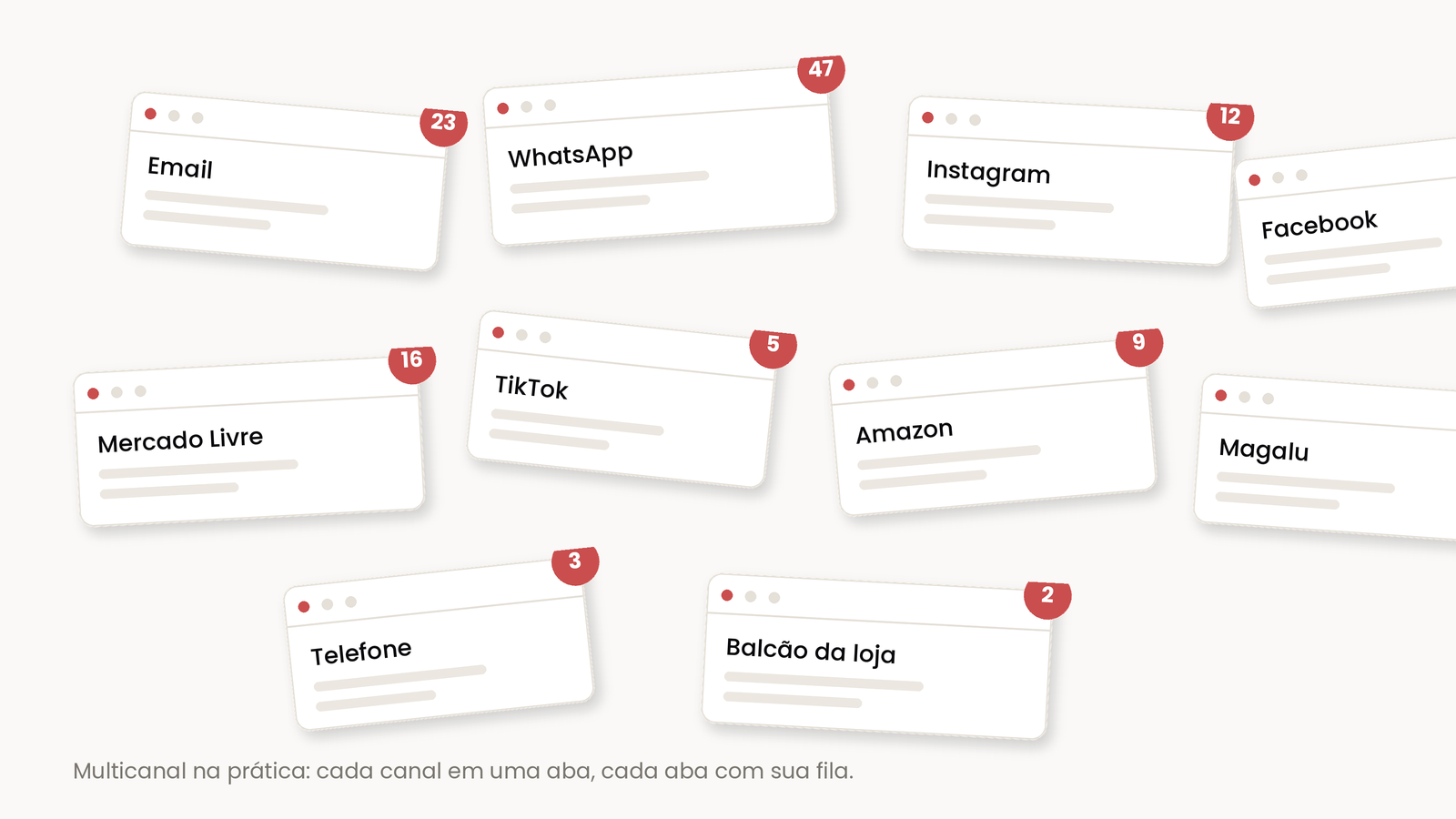
At some point I asked to see how his support ran. Here was the scene: two people, each in front of their own computer, with a collection of open tabs. Email, Instagram, WhatsApp, Facebook, TikTok, one tab on Mercado Livre, another on Amazon, another on Magalu. In the middle of all that, the phone ringing and a customer walking up to the counter of the physical store.
There was nothing pulling it together. The work was jumping from tab to tab all day long, a constant Alt+Tab, with that Pavlov's dog conditioning: a notification chimed, they dropped whatever they were doing and rushed to check.
This is what I call multichannel support. And if you manage a support team, I bet you recognized at least a piece of that scene.
Multichannel is not omnichannel
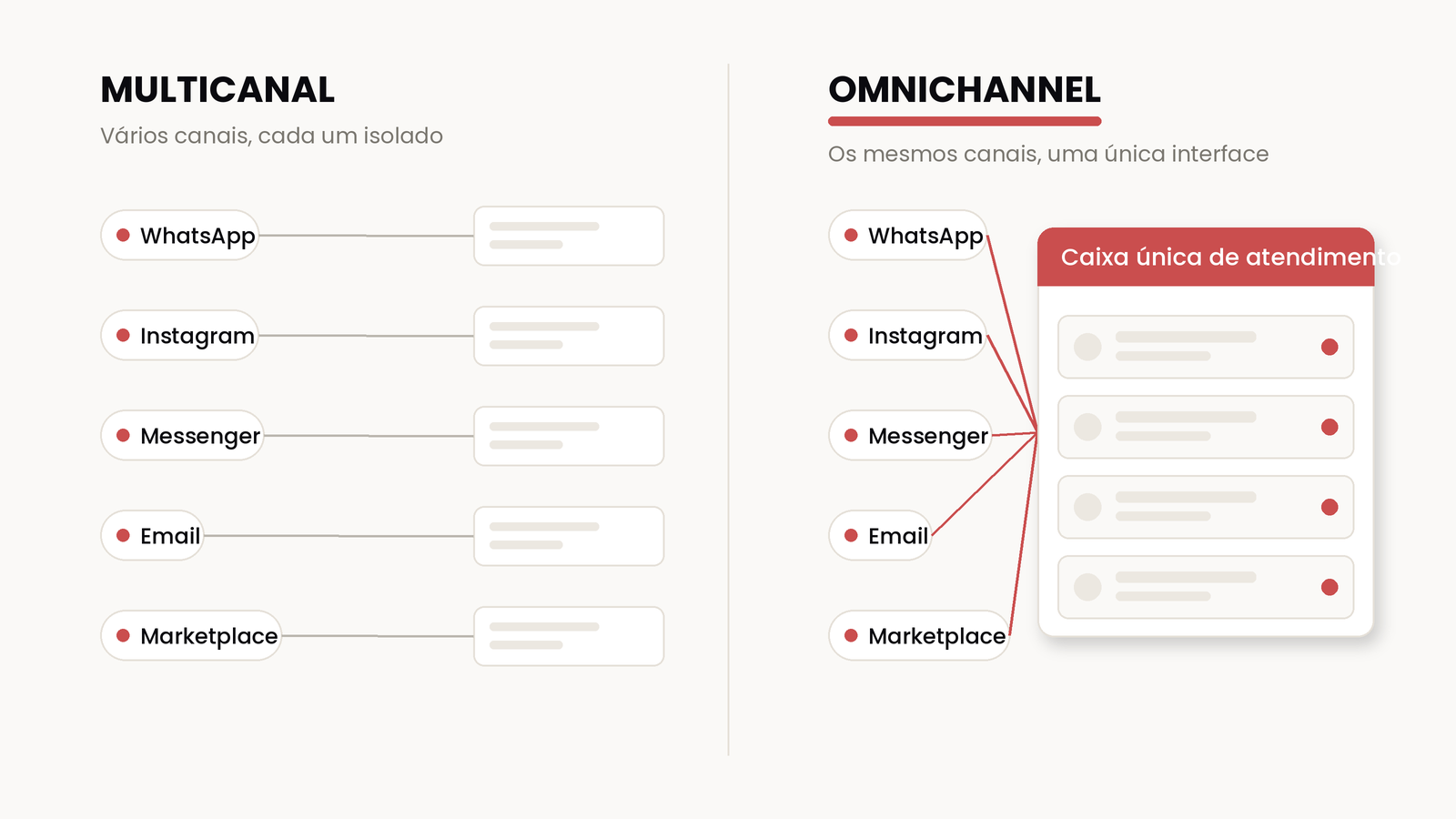
Being present on several channels is being multichannel. Almost every company is today, even without planning it: WhatsApp got added because customers asked for it, Instagram because marketing needed it, the marketplace because sales moved there. Too many channels was never the problem. Each one has its own inbox, its own history and its own invisible queue. The customer who messaged on Instagram yesterday and calls on WhatsApp today is, to your operation, two different people. Nobody sees the whole conversation.
The fix for that has a technical name: omnichannel. In practice, it means every channel flows into a single support interface. The WhatsApp message, the Instagram direct, the email and the marketplace question all become items in the same queue, tied to the same customer, with a single history. A good support CRM does just that: it pulls everything into one queue, with the customer's history.
When I explained this concept to my friend, I did not need a slide or a proposal. He got the value instantly: the time saved, the weight lifted off the team's shoulders, and the end of the Alt+Tab at every little notification chime.
How it works in practice
This is not a setup tutorial, if only because every platform has its own steps. But the principle is the same in any decent system: you connect the channel once and, from there, each new message becomes a ticket in the single support queue. The rules you already use for email and phone start applying to everything: automatic routing to the right agent, priority, response deadline, reporting.
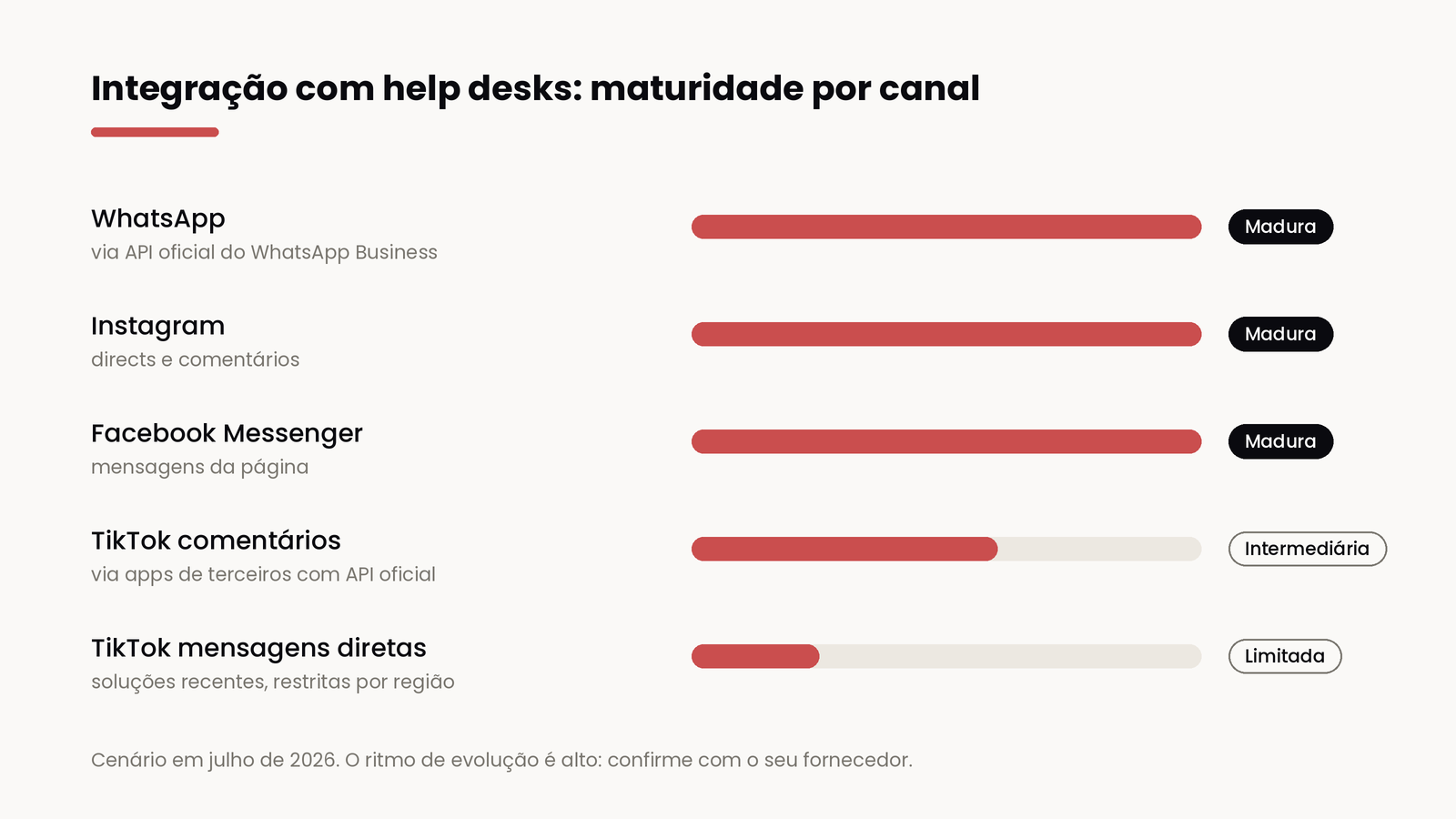
WhatsApp. It is the star, and not because I say so: according to the WhatsApp in Brazil 2025 survey by Opinion Box, 82% of Brazilians have already talked to companies through the app. A serious integration runs through the official WhatsApp Business API (the so-called WhatsApp Business Platform), which allows several agents on the same number, automations, and operating within Meta's rules. Unofficial solutions, the ones that simulate a connected phone, do work for a while. The problem is the risk you take on, and I will say more about it in a moment.
Instagram and Facebook Messenger. The natural sidekicks of WhatsApp, from the same owner, with mature integrations in most good platforms. Directs, comments and page messages land in the same queue, and your team replies without opening the app. Anyone who has ever seen a complaint comment forgotten for three days under a post knows the size of the damage this prevents.
TikTok. Here an honest note, because this is where a lot of vendors promise more than they deliver. Comment integration already works well through third-party apps that use the official API: each video comment can become a ticket, answered straight from the support platform. Messaging is another story. What you can integrate today is TikTok Shop chat, the buyer-to-seller conversation inside the shop, and that requires a TikTok Shop seller account (the shop is now live in Brazil). Organic profile DMs, the kind anyone can send to your brand, are still limited territory in support platforms. If you have volume on TikTok, you can pull in the comments today and, if you sell through the Shop, unify the shop chat too.
And a piece of data that kills the idea of picking a single channel: in the CX Trends survey by Octadesk with Opinion Box, 54% of consumers named WhatsApp as their favorite channel for talking to companies, but email came right behind at 49% and website chat at 45%. In other words, customers use whichever channel they prefer at that moment, and your operation needs to be ready for all of them without fragmenting because of it.
What your team gets out of it
No more context switching. Every tab jump costs focus. With a single queue, the agent processes one conversation at a time, in the right order, without the Pavlov reflex setting the pace of the day.
The history belongs to the customer now. The person who complained on Instagram last week and called on WhatsApp today is one person, and whoever answers sees the whole story before writing the first line.
You can manage by the numbers. Priority, response deadline and per-channel reporting only exist when everything runs through the same funnel. You find out which channel brings the most volume, which brings the most complaints, and where the team spends its day. Without that, management is by gut feel.
And there is the gain that never shows up in a report: less stress. A team that does not live in Alt+Tab makes fewer mistakes and quits less often.
Before you integrate: three technical points
You do not need to master the technical side, but you do need to know what to ask any vendor. There are three points.
1. Official API or shortcut? Ask, in these exact words, whether the WhatsApp integration uses Meta's official API. Unofficial solutions are cheaper and faster to switch on, but they violate the platform's terms, and the risk is binary: the number can get blocked, and your main support channel dies overnight, history and all. For a serious operation, that risk is not worth it.
2. WhatsApp's 24-hour window. Under Meta's rules, when the customer sends a message, a 24-hour window opens in which the company can reply freely. Outside that window, you can only start contact with pre-approved message templates. This shapes your operation: response deadlines have to fit inside the window, and late replies need an approved template. A good vendor handles this in the product, but the manager needs to know the rule exists.
3. WhatsApp is about to start charging per message. Until now, replying to the customer inside the 24-hour window was free. That ends on October 1, 2026: Meta announced in June that service messages, the replies inside that window, will cost around US$ 0.0068 per interaction (about four cents in reais), with volume discounts. Per message, it's tiny. In an operation trading tens of thousands of messages a month, it's a new line in the budget. Integrating is still worth it, it just has to go into the plan: put that cost on the books before the first invoice arrives.
Back at the shop
Nothing got installed that day. What my friend took from the conversation was that he had been serving those channels as if they were ten separate businesses, and the two people in front of the computers were paying for it.
Plugging the social channels into the support system is what lets two people handle ten channels without putting out fires all day.
If the scene of ten open tabs described your team, it is worth a chat. That is the kind of operation I help sort out at Red Lotus, as a Freshworks implementation partner.
Leandro is the founder of Red Lotus Tecnologia, specialized in implementing, supporting, and evolving Freshdesk for support teams in Brazil.
Sources cited in this article
- Opinion Box. "Pesquisa WhatsApp no Brasil 2025." opinionbox.com
- Octadesk and Opinion Box. "CX Trends 2024," via E-Commerce Brasil. ecommercebrasil.com.br
- "API do WhatsApp terá cobrança por mensagens de serviço; entenda." Canaltech, Jun 2026. canaltech.com.br