The VTEX order inside the ticket, before the agent asks.
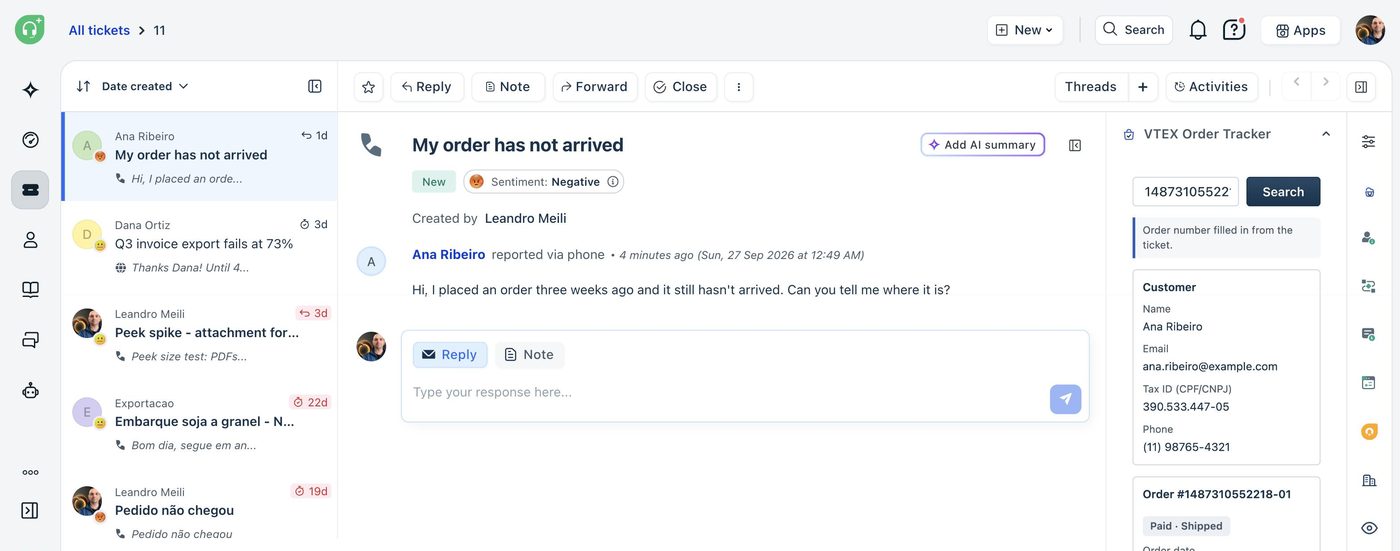
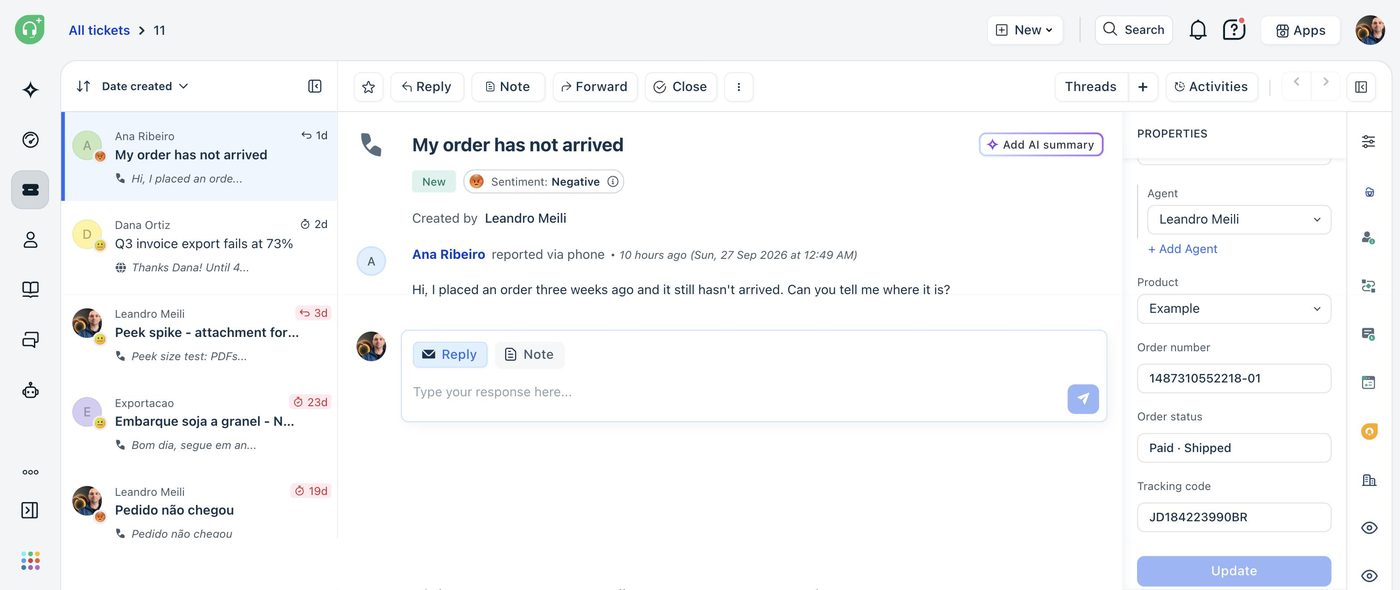
VTEX Order Tracker is our own Freshdesk app. When the ticket already carries the order, the sidebar has fetched the customer and the order from your VTEX account before the agent finishes reading the first line: items, payment, shipping, tracking code. One click writes the order number, the status and the tracking code back into ticket fields that belong to you.
Three places, and every value stays in your Freshdesk.
The app runs inside Freshdesk and keeps no database of its own. What it saves goes into ordinary ticket fields, which means views, automations, exports and reports can use it from then on.
In the ticket sidebar
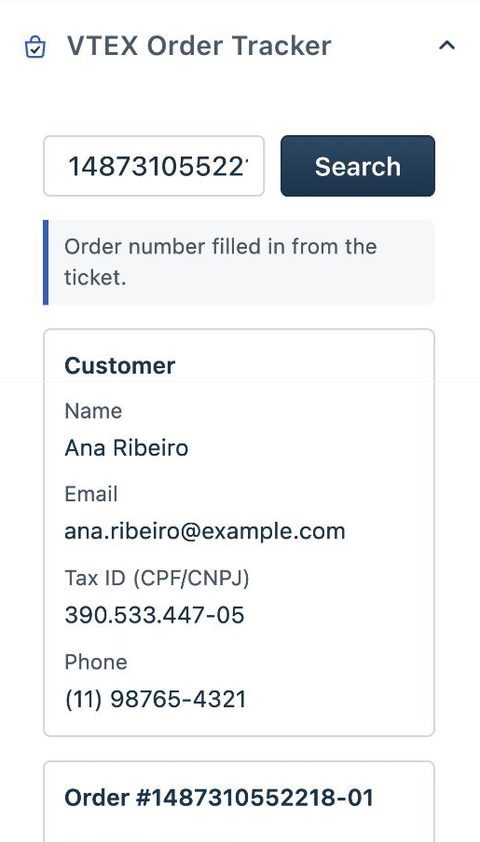
The panel opens beside the conversation. It reads the order from the ticket field you configured and looks it up on its own. Without one, it offers an order quoted in the subject for the agent to confirm, then tries the requester's e-mail address.
In the full order
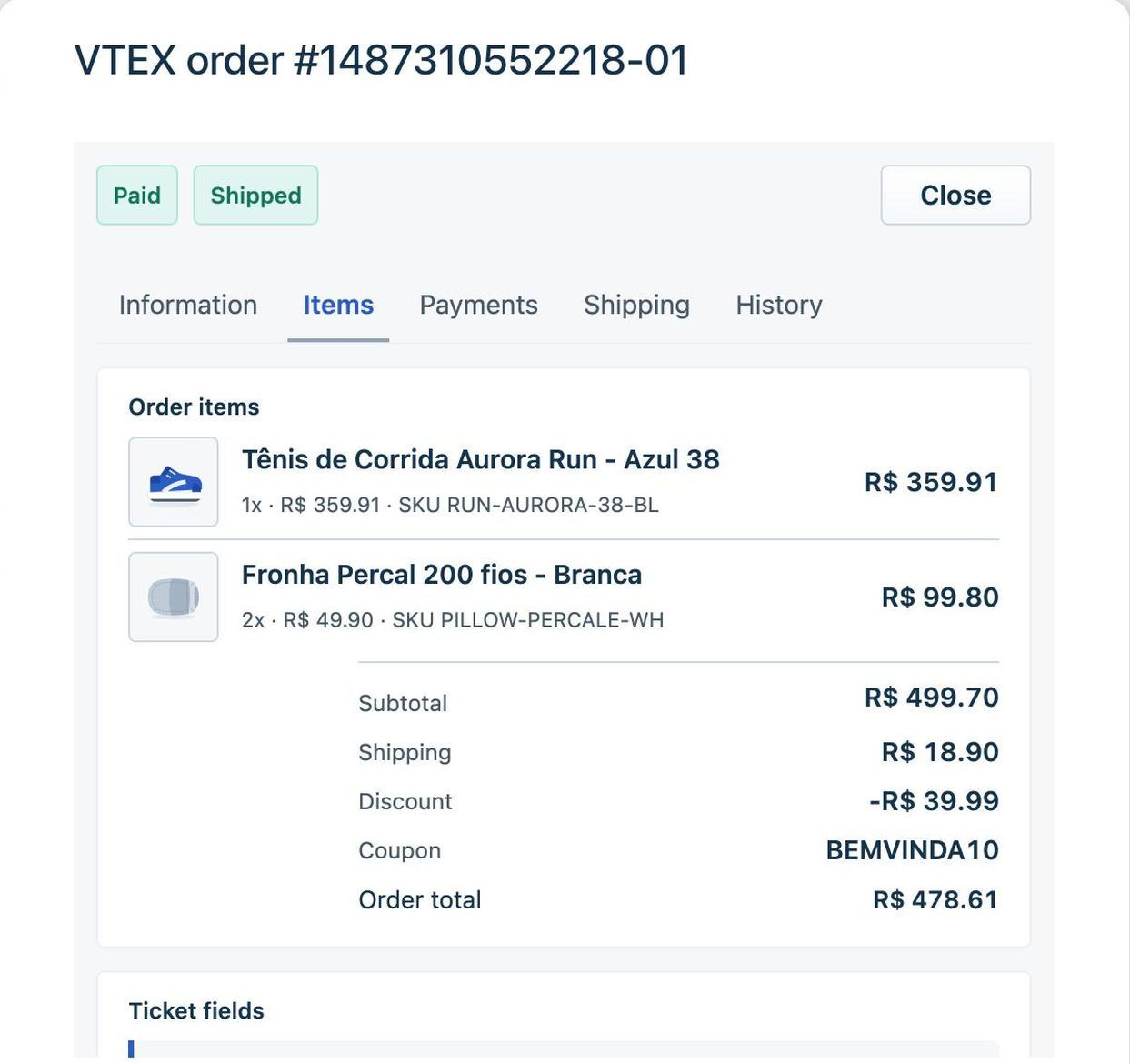
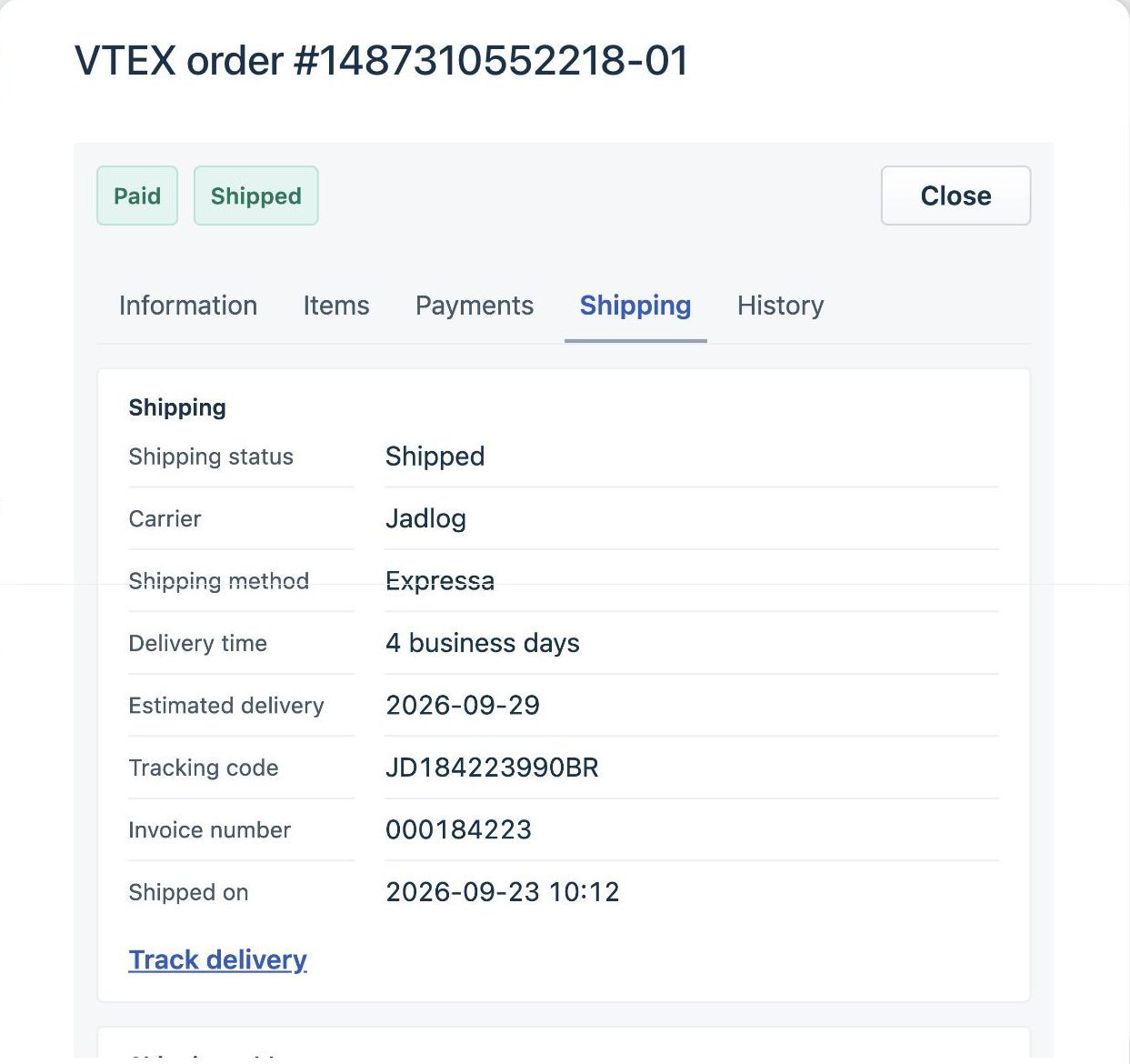
A wide modal with tabs for information, items, payments, shipping and history: item photos, SKUs, coupon, instalments, the boleto link, the carrier, the tracking code and the carrier's own link.
In your own fields
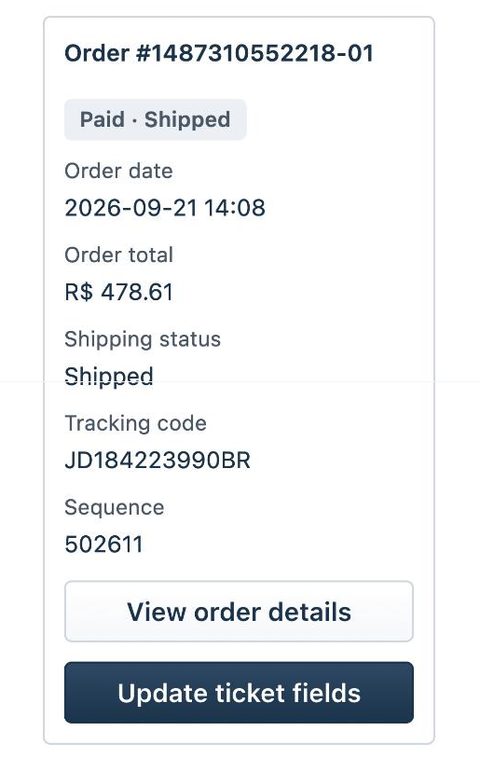
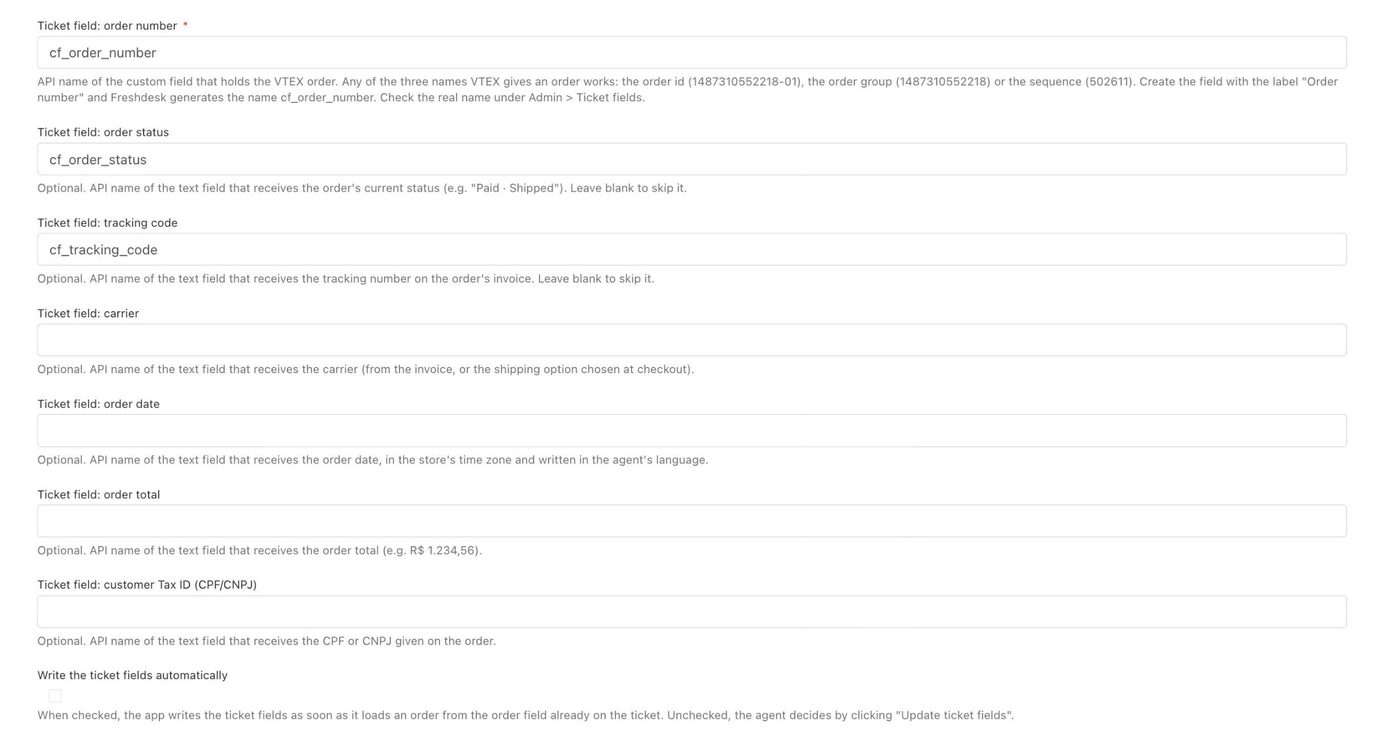
Order number, status, tracking code, carrier, order date, total and CPF/CNPJ go into the custom fields you created, automatically or when the agent presses the button.
What the agent sees in the ticket.
Screenshots taken in a real Freshdesk, with the app answering from its built-in demo store: every name, address and order number below is fictional.
VTEX stores whose support queue is made of orders.
If your agents answer “where is my order?” all day, someone is copying an order number into the VTEX admin right now. With the app, the order shows up inside the ticket.
“Where is my order?”
The most common ticket in any store. The answer is a status and a tracking code, and both are on screen before the agent types a word.
Delivery running late
The shipping tab carries the carrier, the shipping option, the estimate, the invoice and the dispatch date, so the agent answers with a date instead of a guess.
Unpaid or cancelled
An order waiting on a boleto shows the boleto link. A cancelled order says so up front, with the reason, before anyone promises a delivery.
Split checkouts
One purchase split between sellers or warehouses becomes several VTEX orders. The app lists them side by side and lets the agent pick, instead of guessing.
Returns and exchanges
What was bought, at what price, with which coupon and how it was paid: the whole order, before the conversation about sending it back starts.
Nothing changes in the store
Every call the app makes to VTEX is a read. The application key only needs read roles, and the app never edits an order or a customer.
About ten minutes to install.
Create the ticket fields
Single line text, one per value you want written: order number, status, tracking code, carrier, order date, total, CPF/CNPJ. Only the order number is required; leave any other mapping blank and the app skips that field.
Create a VTEX application key
In the VTEX admin, under Account settings › Application keys, with a role that has OMS View order and List orders and Master Data Read only documents. Keep the app key and the app token: VTEX shows the token only once.
Install and map the fields
On the installation page: your VTEX account name, the key and the token, your Freshdesk subdomain and an API key allowed to update tickets, then one API name per ticket field. The page checks every credential against VTEX and Freshdesk as you type, and tells you which of your fields are missing.
Open a ticket
The app appears in the right-hand sidebar. If the ticket carries an order, it has already searched.
Prefer to look before creating a key? Tick Demo mode on the installation page and the app answers from a built-in fictional store, calling no VTEX API at all. The interface is in English, and in Brazilian Portuguese for agents whose Freshdesk is set to Portuguese; an admin can also fix one language for the whole helpdesk.
There is no server of ours.
We keep nothing on our side. The app is HTML and JavaScript running inside your Freshdesk account, with no backend, database or telemetry, and your data goes to exactly two places: your store's VTEX account and your own Freshdesk. Nothing reaches us. We could not read your orders if we wanted to.
The VTEX app key and token and the Freshdesk API key are declared as secure installation parameters. The Freshworks platform encrypts them, substitutes them into the request server-side, and never returns them to the browser. The VTEX host is checked to be a VTEX host before anything is sent, and uninstalling the app removes every credential with it.
Everything arriving from VTEX or from the ticket is written to the page as text, never as markup, so a value a shopper typed cannot execute in an agent's browser. Links that come from third parties (tracking URLs, product images, boleto links) are used only when they are http or https addresses.
Questions before you install.
What does it cost?
It is a paid app: per Freshdesk agent, per month, starting with a free trial. Freshworks bills it on your Freshworks account, and the price and the trial length are stated on the Marketplace listing. We never see your payment details.
Which order number does it use?
Any of the three VTEX gives an order. The order id (1487310552218-01), the order group the shopper saw at checkout (1487310552218), and the short sequence most stores print in their e-mails (502611). Each has an exact VTEX endpoint, so nothing is guessed from a fuzzy search. A group with several orders is listed, not opened.
What if the ticket has no order number?
An order quoted in the subject is filled in for the agent to confirm, never looked up on its own, since a false match would show somebody else's purchase. Otherwise the app searches the requester's e-mail. The agent can also type an order, an e-mail or a CPF/CNPJ by hand.
What about VTEX's masked e-mails?
VTEX sometimes hands out an alias instead of the shopper's address. The app unwraps the real address when the alias carries it, prefers the one on the customer's profile, and flags the alias when there is nothing better, so the agent knows a reply still reaches the customer through VTEX.
Does it change my tickets on its own?
Only the fields you mapped, only if you turned automatic updates on, and only for an order that came from the ticket's own field. Otherwise nothing is written until an agent presses “Update ticket fields”.
Which Freshdesk plan do I need?
One with ticket custom fields and API access. The app writes through the Freshdesk API using a key you supply, so the key's agent needs permission to update tickets.
Where do I get it?
It is on its way to the Freshworks Marketplace. Until it lands there, talk to us and we install it in your account as a custom app.
Can it be customised?
Yes. The code is ours, so another field, another search rule or a link into your ERP is something we can quote as a project.
Answer “where is my order?” without leaving the ticket.
We install it, map your fields and walk your agents through it. Come talk to us.
Back to all solutions